Menopause hair · Evidence led
Shedding, thinning or breakage: what is different?
Three things can look the same in a hairbrush. Here is how to tell them apart and why it matters for what you do next.
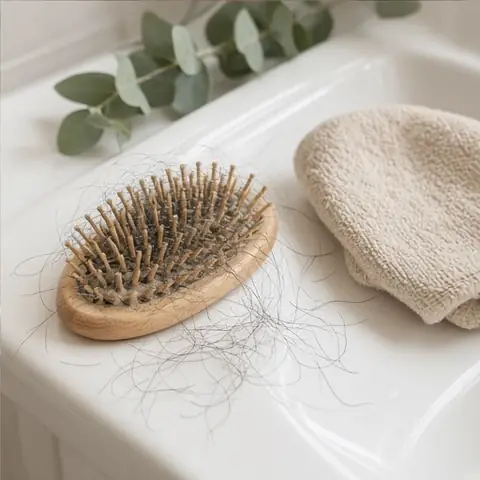
In the consultation room, the first question was nearly always the same: "Is it falling out or breaking off?" Women would arrive with a little bag of hair from their brush, worried that it meant the worst. Often the answer was more hopeful than they expected. Sometimes it pointed to something that needed a doctor. Either way, knowing which pattern you are looking at changes what you do next.
This article explains the three most common patterns during menopause: shedding, thinning and breakage. It is education, not a diagnosis. Read our starting guide to menopause hair loss for the bigger picture.
Key points
- Shedding means more hairs falling from the root, often 2 to 4 months after a trigger.[1]
- Thinning usually means female pattern hair loss: finer hairs and a slowly wider parting.[2][3]
- Breakage means hairs snapping along their length, often from heat, chemicals or tension.
- Two or all three can happen together.[3]
- Patches, a receding hairline or a sore scalp need a doctor promptly.[4][5]
Shedding: more hair from the root
Every day you lose some hair from the root. That is normal. Losing between 50 and 100 hairs a day is typical and most people never notice it.[6][1]
Telogen effluvium is the medical name for a period of heavier shedding. Many more hairs than usual move into the resting phase together and then fall out.[7] It usually looks like:
- more hair than usual in the shower, on your pillow or in your brush
- loss spread across the whole scalp rather than one area
- hairs that are full length with a small pale bulb at one end
- a ponytail that feels thinner even though the parting looks similar
The timing is the biggest clue. Most people notice the extra hair two to four months after the trigger, not when it happens.[1] Common triggers include high fever, an operation, illness, sudden weight loss, a big change in diet, iron deficiency, thyroid changes, some medicines and severe stress.[1][7][8] Hormonal change around menopause is also listed among possible triggers.[8]
The hopeful part is that it often eases. Shedding may feel like several hundred hairs a day and then settle over 6 to 9 months once the body has reset.[1][8] If the trigger continues, for example ongoing stress or untreated low iron, the shedding can continue too. There is also a longer lasting form, chronic telogen effluvium, which can carry on for years and sometimes overlaps with pattern thinning.[3]
Thinning: finer hair and a wider parting
Female pattern hair loss is different. Instead of extra hairs falling, follicles slowly produce shorter, finer hairs. The growing phase shortens and follicles become smaller, a process called miniaturisation.[3] Over months and years this shows up as:
- a centre parting that slowly looks wider
- more scalp visible on top of the head under bright light
- a front hairline that usually stays where it is
- a thinner ponytail
- scalp skin that looks normal and is not usually itchy or sore[2][9]
Because follicles cycle more quickly, daily shedding can rise even before the parting looks obviously wider.[3] That is one reason the patterns can be confusing. Female pattern hair loss becomes more common with age and after menopause. In a UK study it was found in 6% of women under 50 and 38% of women aged 70 and over.[10]
Breakage: hairs snapping along the length
Breakage is not hair loss from the follicle at all. The hair snaps somewhere along its length, leaving short pieces. Around menopause many women notice their hair feels drier or more fragile. Years of colour, heat and tension can add up.[4][11]
Signs of breakage include:
- lots of short pieces, often a few centimetres long, on towels or clothes
- no small bulb at the end of the broken piece
- frayed, split or blunt ends
- shorter hair around the hairline, temples or where you tie your hair
- more breakage where hair is heated, bleached, relaxed or pulled tight
Breakage is often the most fixable of the three, because gentler care can make a visible difference. Our gentle haircare routine for midlife covers washing, drying, colour and tension.
One important caution: breakage at the crown, especially with bumps, tenderness or itch, can be an early sign of a scarring condition called CCCA. Do not assume styling is the only cause.[12]
A simple at home check
You do not need special equipment. For one week, try this:
- Collect what you find. Gather hairs from your brush and shower for a few days in a small clear bag or on a white tissue.
- Look at the ends. Full length hairs with a tiny pale bulb suggest shedding. Short pieces with no bulb suggest breakage.
- Check your parting. Part your hair in the same place in daylight. Take one photo. Repeat once a month rather than every day.
- Think back 2 to 4 months. Write down any illness, fever, surgery, stress, diet change or new medicine.
- Notice your scalp. Is it comfortable, or itchy, sore, red or scaly?
Avoid counting every strand every day. It rarely helps and can make worry worse. A few consistent notes are far more useful to a hair expert or GP. Light, curl pattern, colour and a fresh parting all change how much scalp shows, so a photo is a clue rather than a diagnosis.[9][5]
When it is more than one thing
Real life is rarely tidy. A woman with slowly widening thinning may also have a stressful year and a few months of heavier shedding. Someone with dry, colour treated hair may break more and shed more after an illness. Telogen effluvium can coexist with female pattern hair loss.[1][3] This is exactly why an experienced eye on your scalp is so valuable.
Who to see
Who to see
Gradual change, no warning signs: a qualified trichologist or a hairdresser experienced with thinning hair can look closely at the scalp and hair fibre, help you tell the patterns apart and suggest care and styling.
Heavy shedding that does not settle, tiredness, heavy periods or a new medicine: see your GP, who may consider blood tests such as ferritin and thyroid function.[4][6]
See your GP promptly if you notice
- Sudden or patchy hair loss
- A hairline moving back, or eyebrow loss
- A sore, burning, red or scaly scalp
- Spreading breakage or thinning at the crown with bumps or tenderness
Want the full toolkit?
The Menopause Hair Guide includes a printable observation sheet, pattern diagrams, a scarring warning companion, a shedding tracker and a monthly photo method, alongside routines for every hair texture.
Keep reading
- Menopause hair loss: a clear starting point
- Hair thinning after 50: causes worth checking
- A gentle haircare routine for midlife
Frequently asked questions
How can I tell if my hair is shedding or breaking?
Look at the end of the hair. A shed hair is usually full length with a tiny pale bulb at the root end. A broken hair is shorter, has no bulb and often has a blunt or frayed end. Many short pieces on your pillow or towel suggest breakage.
How many hairs a day is too many?
Losing 50 to 100 hairs a day is normal. A sudden increase to several hundred a day, often noticed in the shower or on the pillow, suggests telogen effluvium and is worth discussing with your GP if it continues.
Can shedding and thinning happen at the same time?
Yes. Telogen effluvium can happen on top of female pattern hair loss. Chronic shedding sometimes overlaps with pattern thinning. This is one reason a proper look at the scalp is useful.
Does menopause cause hair shedding?
Hormonal change around menopause is listed among possible triggers for telogen effluvium. Illness, stress, diet change, iron deficiency, thyroid changes and some medicines are common triggers too.
This article is general education, not medical advice. It cannot diagnose or treat any condition. Speak to a qualified hair expert or your GP about hair changes and seek medical help promptly for the warning signs above.
Sources
Sources were checked on 8 November 2026. Numbers in the text link to this list.
- American Academy of Dermatology. Do you have hair loss or hair shedding?. Source
- British Association of Dermatologists and British Hair and Nail Society. Hair loss: female pattern (androgenetic alopecia). Patient Information Leaflet. Updated October 2024. Next review October 2027. Source
- Sheffield Teaching Hospitals NHS Foundation Trust. Female pattern hair loss. Patient information leaflet PIL1150. Source
- Women’s Health Concern (patient arm of the British Menopause Society). Menopausal hair loss: more than ‘a bad hair day’. Factsheet. November 2025. Source
- British Association of Dermatologists. Frontal fibrosing alopecia. Patient information leaflet. Updated July 2018. Source
- NHS. Hair loss. Page last reviewed 24 January 2024. Next review due 24 January 2027. Source
- Headington JT. Telogen effluvium: new concepts and review. Arch Dermatol. 1993;129(3):356 to 363. PMID: 8447677. Source
- NHS Devon (MyHealth Devon). Alopecia (hair loss). Source
- American Academy of Dermatology. Thinning hair and hair loss: could it be female pattern hair loss? Last updated 13 December 2022. Source
- Birch MP, Messenger JF, Messenger AG. Hair density, hair diameter and the prevalence of female pattern hair loss. Br J Dermatol. 2001;144(2):297 to 304. PMID: 11251562. Source
- Ali I, Wojnarowska F. Physiological changes in scalp, facial and body hair after the menopause: a cross-sectional population-based study of subjective changes. Br J Dermatol. 2011;164(3):508 to 513. PMID: 21128905. Source
- American Academy of Dermatology. Hair loss types: Central centrifugal cicatricial alopecia signs and symptoms. Updated 14 March 2022. Source