Menopause hair · Evidence led
Menopause hair loss: a clear starting point
Why hair changes around menopause, how to tell the common patterns apart, when to see a hair expert or your GP and what the evidence says about care and treatment.
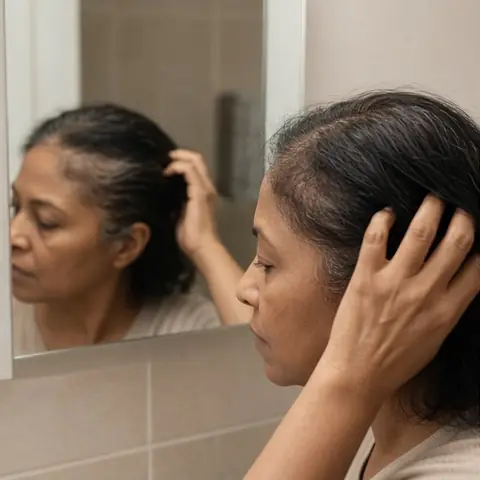
I have lived through menopause myself and I spent seven years working alongside a specialist in women's hair loss. In that time I sat with many women who had noticed the same things: a fuller hairbrush, a wider parting under the bathroom light, a ponytail that suddenly felt thinner. Many had been told to "just live with it". Very few had been given a calm, honest map.
This page is that map. It explains what is happening, how to tell the common patterns apart, who to see first and what the research really says. It is general education, not medical advice. Every health claim links to its source at the bottom of the page.
Key points
- Hair changes around menopause are common. Female pattern hair loss affects more women with every decade after 50.[1][2]
- Hormones are part of the picture, not the whole of it. Genetics, age, iron, thyroid, stress, medicines and styling matter too.[3][4]
- For gradual change with no warning signs, a qualified trichologist or experienced hairdresser is a good first stop. Your GP is for tests, HRT, prescriptions and warning signs.[3][5]
- No treatment works for everyone and female pattern hair loss has no cure. Topical minoxidil has the strongest trial evidence.[6][7]
- Sudden or patchy loss, a sore or scaly scalp or a receding hairline needs a doctor promptly.[3][8][9]
Is menopause hair loss normal?
Yes, it is common. You are not being vain for caring about it. Losing between 50 and 100 hairs a day is normal at any age, often without you noticing.[5][10] What changes around menopause is the balance: some women shed more, some notice finer hair, some see more scalp along the parting and many notice all three at different times.
The numbers back up what so many women say. In a UK study of 377 women, female pattern hair loss was found in 6% of women under 50 and in 38% of women aged 70 and over.[1] An Australian community study found an age adjusted prevalence of 32.2%.[2] A cross-sectional study of postmenopausal women also found it was common after menopause.[11] Figures differ with method and population, yet the direction is consistent: it becomes more common with age and after menopause.
Common does not mean you have to ignore it. Hair loss can affect self esteem, body image and confidence at work and with friends.[12][13] Studies have found that pattern hair loss can be more distressing for women than for men.[14] If it is getting you down, that is a good reason to ask for help.
Why does menopause affect your hair?
Hair is not a fixture. Each follicle on your scalp works through a repeating cycle.[4]
- Anagen is the growing phase. It usually lasts about 2 to 7 years.
- Catagen is a short transition of around three weeks.
- Telogen is a resting phase of about three months.
- Exogen is when the old hair is shed and a new one carries on growing.
At any time most scalp hairs, often quoted as about 85% to 90%, are growing.[4] Because neighbouring follicles are out of step, we shed a little every day rather than all at once.[15]
Oestrogen, androgens and the shifting balance
Oestrogen (spelt estrogen in American papers) appears to help keep hair in its growing phase.[3][4] You may have seen this in pregnancy, when hair often feels thicker, followed by a shed a few months after birth.[10][4]
At menopause, ovarian oestrogen falls quite sharply while androgens such as testosterone decline more slowly. The balance between them shifts.[4][16] On the scalp, in women who are genetically prone, androgens can contribute to shorter, finer hairs. The same shift helps explain why a little extra facial hair is also common after menopause.[4][17]
It is not only hormones
Many women with pattern thinning have completely normal hormone levels.[15] Genetics matter, from either side of the family.[3][6] Age itself reduces hair density and diameter, separate from the date of your last period.[1][16] Women's Health Concern is clear that hormones are not the only cause.[3] This is why a good assessment looks at your whole story, not just your age.
The three patterns most women notice
Telling the patterns apart is the most useful thing you can do before an appointment. More than one can happen at the same time. Our article on shedding, thinning and breakage goes into more detail.
1. Female pattern hair loss: a slowly widening parting
Doctors usually call it female pattern hair loss rather than "female baldness" because complete baldness in women is uncommon.[15] Typical signs include:[6][18][15]
- a wider centre parting and more visible scalp on top
- finer, shorter hairs in that area
- a front hairline that usually stays in place
- a thinner ponytail
- a gradual change over years, most often noticed in your 40s, 50s or 60s
The scalp itself usually looks normal and is rarely itchy or sore.[6] Normal blood tests do not rule it out.[6][15]
2. Telogen effluvium: a sudden, all over shed
Telogen effluvium is the medical name for a period when many more hairs than usual move into the resting phase and then fall out. Triggers include high fever, an operation, illness, sudden weight loss, a big change in diet, iron deficiency, thyroid changes, some medicines and severe stress.[10][19][20] Hormonal change around menopause is also listed among possible triggers.[20]
The timing is the clue. Most people notice the extra hair two to four months after the trigger, not on the day it happens.[10] Shedding can feel closer to several hundred hairs a day, then often eases over 6 to 9 months once the body has reset.[10][20] An ongoing trigger can keep it going.[10]
3. Breakage: short, snapped strands
Not every lost hair comes from the root. Hair that has dried out, been coloured or bleached often or heated daily can snap along its length. Tight styles can pull at the hairline over time. If you find many short broken pieces rather than full length hairs with a tiny bulb at the end, breakage may be part of the story. Breakage at the crown can occasionally be an early sign of a scarring condition, so do not assume styling is the only cause.[9]
Can it start in perimenopause?
Yes. Many women first notice changes in their 40s, years before their last period. Female pattern hair loss is most often noticed in the 40s, 50s or 60s and it can start earlier.[6][15] Perimenopause can also bring heavier or more frequent periods, which can lower iron stores, as well as stress, which is a well known trigger for shedding.[10][21][19] If you are under 45, have irregular periods or are not sure whether you are in perimenopause, your GP can talk through your symptoms. Hormone tests are not usually needed to diagnose menopause in women aged 45 or over, but age and situation change that conversation.[22]
It is also worth knowing that perimenopause does not mean pregnancy is impossible. That matters for some treatments, so mention it to your pharmacist or GP before starting anything new.[23]
Other causes worth checking
Menopause often arrives at the same time as other changes. Before you put everything down to hormones, it is worth thinking about:[3][5][24]
- Iron. Lower ferritin (iron stores) has been linked with some types of hair loss in women, though studies do not all agree.[25][26][27] Heavy periods in perimenopause can lower iron.
- Thyroid. Both an underactive and overactive thyroid can affect hair. Tiredness, feeling cold or hot, palpitations and weight change are clues.[3]
- Diet. Crash dieting and very low protein intake can affect hair growth.[3] See our guide to nutrition for menopausal hair.
- Medicines. Some medicines can cause shedding. Never stop a prescribed medicine yourself; talk to your GP or pharmacist.[5]
- Stress and illness. Both are well known triggers for shedding a few months later.[10][19]
- Scalp conditions. Itch, redness, scale or soreness point to the scalp itself and need checking.[3]
We cover these in more depth in hair thinning after 50: causes worth checking.
Warning signs: when not to wait
Most menopausal hair change is gradual and not dangerous. A few patterns need a doctor promptly, because some types of hair loss can scar the follicle and become permanent.[8][9]
See your GP promptly if you notice
- Sudden or patchy hair loss
- A hairline that is moving back in a band, or eyebrow loss
- A sore, burning, itchy, red or scaly scalp, or smooth shiny patches
- Spreading thinning or breakage at the crown, sometimes with bumps or tenderness
- Hair loss with unexplained weight change, extreme tiredness or other new symptoms
- Hair loss that started after a new medicine (do not stop it yourself)
Frontal fibrosing alopecia can move the front hairline back in a band and affect the eyebrows.[8] Central centrifugal cicatricial alopecia (CCCA) often starts at the crown and is more common in Black women. Early signs can include breakage, bumps, tenderness or itch, though some people feel nothing at all.[9] Neither is a reason for blame and both deserve early specialist care.
Who to see first: a hair expert or your GP?
This is where my years beside a specialist changed how I think. Many women go straight to their GP and leave with a blood test and little else. Others spend hundreds of pounds on products before anyone has looked at their scalp. Neither is ideal.
Who to see
For gradual thinning or shedding with no warning signs: start with a qualified trichologist or a hairdresser experienced with thinning hair and your texture. They can look at the pattern, scalp and hair fibre, advise on scalp care, cuts, colour, styling, toppers and camouflage and track progress over time.
For tests, HRT, prescription treatment or any warning sign: see your GP. They can look for medical causes, arrange relevant blood tests and refer you to a dermatologist if needed.[3][5][22]
A good hair expert knows their limits and refers you on when something needs medical care. In the UK, the Institute of Trichologists explains its registration grades and can confirm a registrant.[28] The International Association of Trichologists lists certified members worldwide.[29] Registration is not a medical licence, so ask how they decide when to send you to a doctor.
Walk away from anyone who promises guaranteed regrowth, pushes you to pay today or tells you to stop a prescribed medicine.
Preparing for your appointment
You will get more from any appointment if you bring:
- When you first noticed the change and whether it was sudden or gradual.
- Where you see it: parting, crown, temples, hairline, patches or all over.
- Anything that happened 2 to 4 months before: illness, fever, surgery, stress, diet change, a new medicine.
- A list of all medicines and supplements, including biotin. Biotin can distort some blood tests, including some heart tests.[30][31]
- Your menopause stage and symptoms such as hot flushes, sleep and mood.
- A few photos of your parting, taken in the same light once a month.
Not everyone needs every blood test. Your GP will choose based on your history. Tests your GP may consider include a full blood count and ferritin, thyroid function and, in some cases, other nutrients or hormones.[3][22] Hormone tests are usually not needed to diagnose menopause in healthy women aged 45 or over.[22]
What the research says about treatment
There is a lot of noise online. Here is the honest summary, with full detail in our evidence guide to menopause hair loss treatments.
- Topical minoxidil has the strongest trial evidence for female pattern hair loss. A Cochrane review of 47 trials found that about twice as many women reported at least moderate regrowth compared with placebo. Evidence quality was mostly moderate to low.[7] It takes months, does not work for everyone and any benefit lasts only while you keep using it.[6][32] In the UK, licensing is product specific, so ask your pharmacist which product suits you.[23]
- HRT is offered for menopause symptoms after a discussion of benefits and risks. It is not recommended as a treatment for hair loss on its own.[22]
- Low dose oral minoxidil is prescribed off label by some specialists. Early evidence is encouraging and larger trials are needed. It is a decision for a prescriber, never something to buy online.[6][33][34]
- Finasteride did not help postmenopausal women in a year long trial. The NHS advises that women should not use it.[5][35]
- Laser devices, PRP and rosemary oil have early or limited evidence.[6][36][37]
- Supplements have weak evidence unless you have a proven deficiency.[24][18]
Female pattern hair loss cannot be cured, though it often progresses slowly.[6] Women's Health Concern notes that most menopause related hair loss slows down with time.[3] That is not a reason to do nothing. It is a reason to choose calm, realistic steps over expensive promises.
Everyday care that makes a real difference
Daily care cannot change your genes, yet it can reduce breakage, keep your scalp comfortable and help the hair you have look its best.[3][18]
- Wash for your scalp, not a schedule. Shampoo the scalp, condition the lengths and adjust frequency to your texture and comfort.
- Turn the heat down. Women's Health Concern suggests that using fewer straighteners and dryers may improve how menopausal hair looks.[3]
- Loosen up. Swap tight elastics for soft scrunchies and give your hairline a break from tension.
- Protect your parting from the sun with a hat or sun cream on exposed scalp.[3][6]
- Rethink the cut. Soft layers, a fringe or an off centre parting can make thinning far less noticeable.
- Eat enough protein at most meals and follow NHS advice on vitamin D in autumn and winter.[38][39]
Our gentle haircare routine for midlife walks you through it step by step for every hair type.
Looking after how you feel
Hair loss is rarely "just hair". It is part of how we recognise ourselves. A BMJ review described anxiety, low mood and difficulties in social and working life among people living with alopecia.[12] A meta-analysis found pattern hair loss was linked with lower quality of life and self esteem.[13] If your hair is affecting your wellbeing, tell your GP. Alopecia UK offers support groups and resources.[40]
In my experience, the women who felt better soonest were not always the ones with the biggest change in their hair. They were the ones who stopped searching alone at midnight, got a proper look at their scalp and had a plan they believed in.
A realistic 12 week starting plan
Hair grows about 1 cm a month. Most treatments are judged over 6 to 12 months.[6][15] Twelve weeks is long enough to notice patterns, see the right person and build a routine you can keep, without expecting a miracle.
- Weeks 1 to 4: notice and prepare. Check the warning signs, take baseline photos, list your medicines and book a qualified hair expert. Contact your GP promptly for any red flag.
- Weeks 5 to 8: build the routine. Settle into a gentle wash and styling routine with your hair expert. Discuss tests, HRT or treatment questions with your GP.
- Weeks 9 to 12: review and decide. Compare photos, look at your notes and plan the next season of care with honest expectations.
Where The Menopause Hair Guide fits
If you want everything on this page in one calm, printable place, The Menopause Hair Guide is our 64 page PDF. It includes the observation sheet, pattern diagrams, a GP appointment script, a hair expert checklist, an overview of treatments and the research behind them, a 7 day meal plan, scalp and styling routines for every texture and a 12 week plan with trackers. It draws on 43 sources. It is education and support, not a diagnosis or a treatment. It cannot promise regrowth.
Keep reading
- Shedding, thinning or breakage: what is different?
- Hair thinning after 50: causes worth checking
- Menopause hair loss treatments: an evidence guide
- A gentle haircare routine for midlife
- Nutrition and menopausal hair: food first
Frequently asked questions
Does menopause cause hair loss?
Menopause can play a part. Falling oestrogen shifts the hormone balance that hair follicles work in. Female pattern hair loss also becomes more common with age and after menopause. Hormones are not the only cause though. Genetics, age, iron, thyroid changes, stress, illness, medicines and styling can all contribute.
Will my hair grow back after menopause?
It depends on the cause. Shedding after a trigger such as illness or stress often settles over 6 to 9 months once the trigger has passed. Female pattern hair loss is usually gradual and cannot be cured, though treatment can slow it and some women see regrowth while a treatment continues. Scarring types of hair loss need prompt medical care because lost follicles may not recover.
How much hair loss is normal in menopause?
Losing roughly 50 to 100 hairs a day is normal at any age. A sudden rise to several hundred a day, a clearly wider parting, patches or a hairline moving back are worth getting checked.
Should I see a trichologist or my GP about menopause hair loss?
For gradual thinning or shedding with no warning signs, a qualified trichologist or an experienced hairdresser is a sensible first step for assessment, scalp care and styling. See your GP for blood tests, HRT, prescription treatments and straight away for warning signs such as sudden or patchy loss, a sore or scaly scalp or a receding hairline.
Does HRT help menopause hair loss?
HRT is offered for menopause symptoms such as hot flushes after a discussion of benefits and risks. It is not licensed or recommended as a treatment for hair loss on its own. Some women notice their hair feels different after starting or changing HRT, in either direction.
How long does menopause hair loss last?
Shedding linked to a trigger often eases within 6 to 9 months. Female pattern hair loss tends to be slow and long term. Women's Health Concern notes that most menopause related hair loss does slow down with time.
This article is general education, not medical advice. It cannot diagnose or treat any condition. Speak to a qualified hair expert or your GP about hair changes and seek medical help promptly for the warning signs above.
Sources
Sources were checked on 8 November 2026. Numbers in the text link to this list.
- Birch MP, Messenger JF, Messenger AG. Hair density, hair diameter and the prevalence of female pattern hair loss. Br J Dermatol. 2001;144(2):297 to 304. PMID: 11251562. Source
- Gan DC, Sinclair RD. Prevalence of male and female pattern hair loss in Maryborough. J Investig Dermatol Symp Proc. 2005;10(3):184 to 189. PMID: 16382660. Source
- Women’s Health Concern (patient arm of the British Menopause Society). Menopausal hair loss: more than ‘a bad hair day’. Factsheet. November 2025. Source
- Grymowicz M, Rudnicka E, Podfigurna A, Napierala P, Smolarczyk R, Smolarczyk K, Meczekalski B. Hormonal effects on hair follicles. Int J Mol Sci. 2020;21(15):5342. PMID: 32731328. Source
- NHS. Hair loss. Page last reviewed 24 January 2024. Next review due 24 January 2027. Source
- British Association of Dermatologists and British Hair and Nail Society. Hair loss: female pattern (androgenetic alopecia). Patient Information Leaflet. Updated October 2024. Next review October 2027. Source
- van Zuuren EJ, Fedorowicz Z, Schoones J. Interventions for female pattern hair loss. Cochrane Database Syst Rev. 2016;(5):CD007628. PMID: 27225981. Source
- British Association of Dermatologists. Frontal fibrosing alopecia. Patient information leaflet. Updated July 2018. Source
- American Academy of Dermatology. Hair loss types: Central centrifugal cicatricial alopecia signs and symptoms. Updated 14 March 2022. Source
- American Academy of Dermatology. Do you have hair loss or hair shedding?. Source
- Chaikittisilpa S, Rattanasirisin N, Panchaprateep R, et al. Prevalence of female pattern hair loss in postmenopausal women: a cross-sectional study. Menopause. 2022;29(4):415 to 420. PMID: 35357365. Source
- Hunt N, McHale S. The psychological impact of alopecia. BMJ. 2005;331(7522):951 to 953. PMID: 16239692. Source
- Huang CH, et al. Health-Related Quality of Life, Depression and Self-esteem in Patients With Androgenetic Alopecia: A Systematic Review and Meta-analysis. JAMA Dermatol. 2021;157(8):963 to 970. PMID: 34232264. Source
- Cash TF, Price VH, Savin RC. Psychological effects of androgenetic alopecia on women: comparisons with balding men and with female control subjects. J Am Acad Dermatol. 1993;29(4):568 to 575. PMID: 8408792. Source
- Sheffield Teaching Hospitals NHS Foundation Trust. Female pattern hair loss. Patient information leaflet PIL1150. Source
- Mirmirani P. Hormonal changes in menopause: do they contribute to a ‘midlife hair crisis’ in women? Br J Dermatol. 2011;165 Suppl 3:7 to 11. PMID: 22171679. Source
- Ali I, Wojnarowska F. Physiological changes in scalp, facial and body hair after the menopause: a cross-sectional population-based study of subjective changes. Br J Dermatol. 2011;164(3):508 to 513. PMID: 21128905. Source
- American Academy of Dermatology. Thinning hair and hair loss: could it be female pattern hair loss? Last updated 13 December 2022. Source
- Headington JT. Telogen effluvium: new concepts and review. Arch Dermatol. 1993;129(3):356 to 363. PMID: 8447677. Source
- NHS Devon (MyHealth Devon). Alopecia (hair loss). Source
- NHS. Iron. Page last reviewed 3 August 2020. Source
- National Institute for Health and Care Excellence. Menopause: identification and management. NICE guideline NG23. Last reviewed 15 April 2026. Source
- McNeil Products Ltd. Regaine for Women Once a Day Scalp Foam 5% w/w Cutaneous Foam. Summary of Product Characteristics. Text revised 12 May 2026, emc updated 1 June 2026. Source
- Almohanna HM, Ahmed AA, Tsatalis JP, Tosti A. The role of vitamins and minerals in hair loss: a review. Dermatol Ther (Heidelb). 2019;9(1):51 to 70. PMID: 30547302. Source
- Kantor J, Kessler LJ, Brooks DG, Cotsarelis G. Decreased serum ferritin is associated with alopecia in women. J Invest Dermatol. 2003;121(5):985 to 988. PMID: 14708596. Source
- Trost LB, Bergfeld WF, Calogeras E. The diagnosis and treatment of iron deficiency and its potential relationship to hair loss. J Am Acad Dermatol. 2006. doi: 10.1016/j.jaad.2005.11.1104. PMID: 16635664. Source
- Treister-Goltzman Y, Yarza S, Peleg R. Iron Deficiency and Nonscarring Alopecia in Women: Systematic Review and Meta-Analysis. Skin Appendage Disord. 2022;8(2):83 to 92. doi: 10.1159/000519952. PMID: 35415182. Source
- The Institute of Trichologists. Classes of registration. Accessed 8 November 2026. Source
- International Association of Trichologists. Locate a Trichologist: International Register of IAT Certified Trichologists. Accessed 8 November 2026. Source
- US Food and Drug Administration. Biotin interference with troponin lab tests: assays subject to biotin interference. Source
- Manchester University NHS Foundation Trust. Potential for biotin interference in immunoassays. Laboratory notice. Source
- Lucky AW, Piacquadio DJ, Ditre CM, Dunlap F, Kantor I, Pandya AG, Savin RC, Tharp MD. A randomized, placebo-controlled trial of 5% and 2% topical minoxidil solutions in the treatment of female pattern hair loss. J Am Acad Dermatol. 2004;50(4):541 to 553. PMID: 15034503. Source
- Randolph M, Tosti A. Oral minoxidil treatment for hair loss: a review of efficacy and safety. J Am Acad Dermatol. 2021. doi: 10.1016/j.jaad.2020.06.1009. PMID: 32622136. Source
- Ramos PM, Sinclair RD, Kasprzak M, Miot HA. Minoxidil 1 mg oral versus minoxidil 5% topical solution for the treatment of female-pattern hair loss: A randomized clinical trial. J Am Acad Dermatol. 2020;82(1):252 to 253. doi: 10.1016/j.jaad.2019.08.060. PMID: 31473295. Source
- Price VH, Roberts JL, Hordinsky M, et al. Lack of efficacy of finasteride in postmenopausal women with androgenetic alopecia. J Am Acad Dermatol. 2000;43(5 Pt 1):768 to 776. PMID: 11050579. Source
- Jimenez JJ, Wikramanayake TC, et al. Efficacy and safety of a low-level laser device in the treatment of male and female pattern hair loss: a multicenter, randomized, sham device-controlled, double-blind study. Am J Clin Dermatol. 2014;15(2):115 to 127. PMID: 24474647. Source
- Panahi Y, et al. Rosemary oil vs minoxidil 2% for the treatment of androgenetic alopecia: a randomized comparative trial. Skinmed. 2015;13(1):15 to 21. PMID: 25842469. Source
- NHS. Vitamin D. Source
- NHS. The Eatwell Guide. Source
- Alopecia UK. Source