Menopause hair · Evidence led
Hair thinning after 50: causes worth checking
Not every change after 50 is menopause. A calm checklist of the causes worth thinking about before you decide what to do.
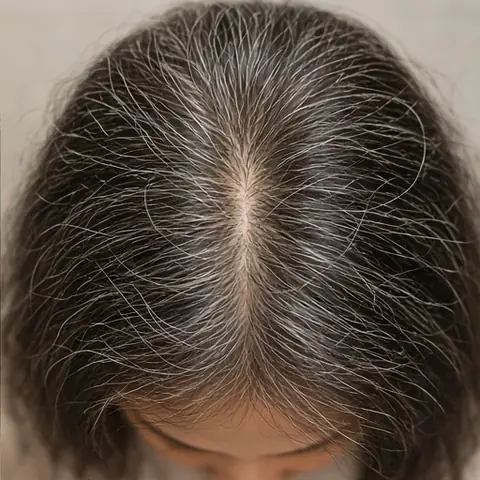
When women over 50 came to the clinic, many had already decided the cause: "It's my age" or "It's the menopause". Sometimes they were right. Often there was more to it, such as low iron after years of heavy periods, a thyroid change, a new medicine or simply a style that had been pulling for decades. Finding those pieces mattered, because some of them can be put right.
This checklist covers the causes worth thinking about when hair thins after 50. It is general education to help you have a better conversation with a hair expert or your GP. Start with our menopause hair loss guide if you want the background first.
Key points
- Age itself reduces hair density and diameter, separate from menopause.[1][2]
- Female pattern hair loss is the most common cause of gradual thinning in later life.[1][3]
- Iron, thyroid, diet, medicines, stress and scalp conditions are all worth checking.[4][5]
- Normal blood tests do not mean you imagined it.[6][7]
- Some scarring hair loss is painless, so a changing hairline or crown still needs checking.[8][9]
1. Female pattern hair loss
This is the most common reason for slow, gradual thinning on top of the head in later life. It becomes more common with every decade. In a UK study of 377 women, it was found in 6% of women under 50 and in 38% of those aged 70 and over.[1] A Sheffield NHS leaflet estimates it affects around 10% of women at 50 and over 30% at 70.[3]
Look for a wider centre parting, finer hairs on top, a front hairline that stays in place and a thinner ponytail.[6][3] Genetics play a part and there may be a family link on either side.[4][6] Many women with this pattern have normal hormone levels, so normal blood tests do not rule it out.[3]
2. Ageing hair
Separate from menopause, hair changes with age. Hair density and the diameter of each hair fall over time.[1][2] Many women also notice texture changes after menopause, with hair feeling drier, coarser or less manageable.[10] Grey hair can behave very differently from pigmented hair. None of this is a failure on your part.
3. Iron and ferritin
Ferritin is a measure of the body's iron stores. Lower ferritin has been associated with some types of hair loss in women, though not all studies agree.[11][12][13] Heavy periods in perimenopause, a low iron diet or problems absorbing iron can all lower it.
What matters most:
- Ferritin is interpreted in context by your clinician, not against a target number from social media.[12][13]
- If a test shows deficiency, your GP may recommend iron at a specific dose and look for the cause.[14]
- Do not guess a high dose yourself. Treating iron without a proven deficiency is not well supported.[12][14]
4. Thyroid changes
Both an underactive and an overactive thyroid can affect hair. Clues include tiredness, feeling unusually cold or hot, palpitations and weight change.[4] Some thyroid symptoms overlap with menopause, which is one reason a GP may consider a thyroid test.[4]
5. Shedding after a trigger
Telogen effluvium is a sudden, all over shed that usually starts two to four months after a trigger such as illness, an operation, high fever, sudden weight loss or severe stress.[15][16] It often eases over 6 to 9 months once the trigger has passed.[15][17] Read more in shedding, thinning or breakage.
6. Medicines and supplements
Some medicines can cause hair shedding. If your hair changed after starting something new, talk to your GP or pharmacist. Never stop a prescribed medicine yourself.[5]
Supplements matter too. High dose biotin, found in many hair and nail products, can distort some laboratory tests, including some heart tests.[18][19] Always tell whoever takes your blood what you take. The lab or your clinician will tell you whether anything needs pausing.
7. Diet and weight change
Crash dieting can affect hair growth.[4] Very low protein intake, skipping meals or losing weight quickly can all play a part. If your appetite has changed or you are losing weight without trying, mention it to your GP. Our guide to nutrition for menopausal hair covers the basics.
8. Styling, colour and tension
Years of tight ponytails, braids, extensions, heat or chemical treatments can lead to breakage and, over time, thinning around the hairline. Women's Health Concern suggests that using fewer straighteners and dryers may improve how menopausal hair looks.[4] Gentle changes here are among the quickest wins. See our gentle haircare routine.
9. Scalp conditions and scarring hair loss
Itch, redness, scale, soreness or burning point to the scalp itself and need a GP rather than a new shampoo.[4]
Two scarring conditions are especially worth knowing about after 50:
- Frontal fibrosing alopecia can move the front hairline back in a band and affect the eyebrows. The skin can look smoother or paler. There may be itch, burning or no discomfort at all.[8]
- Central centrifugal cicatricial alopecia (CCCA) often starts at the crown, especially in middle aged Black women. Early signs can include breakage, bumps, tenderness or itch, though some people feel nothing.[9]
Scarring hair loss can become permanent, so early assessment matters. Treatment aims to protect the follicles that remain.[8][9]
10. Androgen related conditions
Female pattern hair loss can accompany conditions with higher androgen levels, such as polycystic ovary syndrome. New facial hair, acne or unusual cycle changes may be worth mentioning. Many women with thinning have normal androgen levels.[6][3]
Your appointment checklist
- When the change started and whether it was sudden or gradual
- The pattern: wider parting, crown, temples, patches, hairline or all over
- Illnesses, operations, fevers or major stresses in the past year
- All medicines, supplements and herbal products, including biotin
- Your eating pattern, including any weight loss
- Your menopause stage and symptoms: flushes, sleep and mood
- New facial hair, acne or scalp symptoms
- Whether close relatives have pattern hair loss
Which tests might your GP consider?
There is no universal menopause hair test. Not everyone needs every test. Depending on your history, your GP may consider:[4][20]
- Full blood count and ferritin, for diffuse shedding, tiredness, heavy periods or a low iron diet
- Thyroid function, if your symptoms suggest it
- Selected nutrient tests, such as B12, folate or vitamin D, if your diet or symptoms point that way[21]
- Androgen tests, if there are signs such as new facial hair or acne[6]
Hormone tests are usually not needed to diagnose menopause in otherwise healthy women aged 45 or over.[20] If the tests come back normal, that does not mean you imagined the change. Ask what the scalp examination suggests and what happens next.[6][7]
Who to see first
Who to see
Gradual thinning, comfortable scalp, no warning signs: a qualified trichologist or an experienced hairdresser is a good first stop for assessment, scalp care and styling. They should refer you on if something needs medical care.
Tests, HRT, medicines or any warning sign: your GP, who can refer you to a dermatologist if needed.[4][5]
See your GP promptly if you notice
- Sudden or patchy hair loss
- A receding hairline or eyebrow loss
- A sore, burning, red or scaly scalp
- Spreading crown thinning or breakage
- Hair loss with unexplained weight change or extreme tiredness
Everything in one place
The Menopause Hair Guide brings this checklist together with a printable GP script, a blood test conversation sheet, a hair expert checklist and a 12 week plan.
Keep reading
- Menopause hair loss: a clear starting point
- Menopause hair loss treatments: an evidence guide
- Nutrition and menopausal hair: food first
Frequently asked questions
Is it normal for hair to thin after 50?
It is common. Hair density and diameter fall with age. Female pattern hair loss also becomes more common after menopause. A UK study found it in 38% of women aged 70 and over. Common does not mean you should ignore it, especially if the change is sudden or your scalp is uncomfortable.
What blood tests should I ask for if my hair is thinning after 50?
There is no universal hair panel. Depending on your history, your GP may consider a full blood count and ferritin, thyroid function and selected nutrient tests. Hormone tests are usually not needed to diagnose menopause in women aged 45 or over.
Can low iron cause hair thinning after 50?
Lower ferritin has been associated with some types of hair loss in women, though studies do not all agree. If a test shows deficiency, your GP may recommend treatment. Taking high dose iron without a proven deficiency is not well supported.
This article is general education, not medical advice. It cannot diagnose or treat any condition. Speak to a qualified hair expert or your GP about hair changes and seek medical help promptly for the warning signs above.
Sources
Sources were checked on 8 November 2026. Numbers in the text link to this list.
- Birch MP, Messenger JF, Messenger AG. Hair density, hair diameter and the prevalence of female pattern hair loss. Br J Dermatol. 2001;144(2):297 to 304. PMID: 11251562. Source
- Mirmirani P. Hormonal changes in menopause: do they contribute to a ‘midlife hair crisis’ in women? Br J Dermatol. 2011;165 Suppl 3:7 to 11. PMID: 22171679. Source
- Sheffield Teaching Hospitals NHS Foundation Trust. Female pattern hair loss. Patient information leaflet PIL1150. Source
- Women’s Health Concern (patient arm of the British Menopause Society). Menopausal hair loss: more than ‘a bad hair day’. Factsheet. November 2025. Source
- NHS. Hair loss. Page last reviewed 24 January 2024. Next review due 24 January 2027. Source
- British Association of Dermatologists and British Hair and Nail Society. Hair loss: female pattern (androgenetic alopecia). Patient Information Leaflet. Updated October 2024. Next review October 2027. Source
- American Academy of Dermatology. Thinning hair and hair loss: could it be female pattern hair loss? Last updated 13 December 2022. Source
- British Association of Dermatologists. Frontal fibrosing alopecia. Patient information leaflet. Updated July 2018. Source
- American Academy of Dermatology. Hair loss types: Central centrifugal cicatricial alopecia signs and symptoms. Updated 14 March 2022. Source
- Ali I, Wojnarowska F. Physiological changes in scalp, facial and body hair after the menopause: a cross-sectional population-based study of subjective changes. Br J Dermatol. 2011;164(3):508 to 513. PMID: 21128905. Source
- Kantor J, Kessler LJ, Brooks DG, Cotsarelis G. Decreased serum ferritin is associated with alopecia in women. J Invest Dermatol. 2003;121(5):985 to 988. PMID: 14708596. Source
- Trost LB, Bergfeld WF, Calogeras E. The diagnosis and treatment of iron deficiency and its potential relationship to hair loss. J Am Acad Dermatol. 2006. doi: 10.1016/j.jaad.2005.11.1104. PMID: 16635664. Source
- Treister-Goltzman Y, Yarza S, Peleg R. Iron Deficiency and Nonscarring Alopecia in Women: Systematic Review and Meta-Analysis. Skin Appendage Disord. 2022;8(2):83 to 92. doi: 10.1159/000519952. PMID: 35415182. Source
- NHS. Iron. Page last reviewed 3 August 2020. Source
- American Academy of Dermatology. Do you have hair loss or hair shedding?. Source
- Headington JT. Telogen effluvium: new concepts and review. Arch Dermatol. 1993;129(3):356 to 363. PMID: 8447677. Source
- NHS Devon (MyHealth Devon). Alopecia (hair loss). Source
- US Food and Drug Administration. Biotin interference with troponin lab tests: assays subject to biotin interference. Source
- Manchester University NHS Foundation Trust. Potential for biotin interference in immunoassays. Laboratory notice. Source
- National Institute for Health and Care Excellence. Menopause: identification and management. NICE guideline NG23. Last reviewed 15 April 2026. Source
- Almohanna HM, Ahmed AA, Tsatalis JP, Tosti A. The role of vitamins and minerals in hair loss: a review. Dermatol Ther (Heidelb). 2019;9(1):51 to 70. PMID: 30547302. Source