Menopause hair · Evidence led
A gentle haircare routine for midlife
Small, steady care adds up. A simple weekly routine that reduces breakage, keeps your scalp comfortable and helps the hair you have look its best.
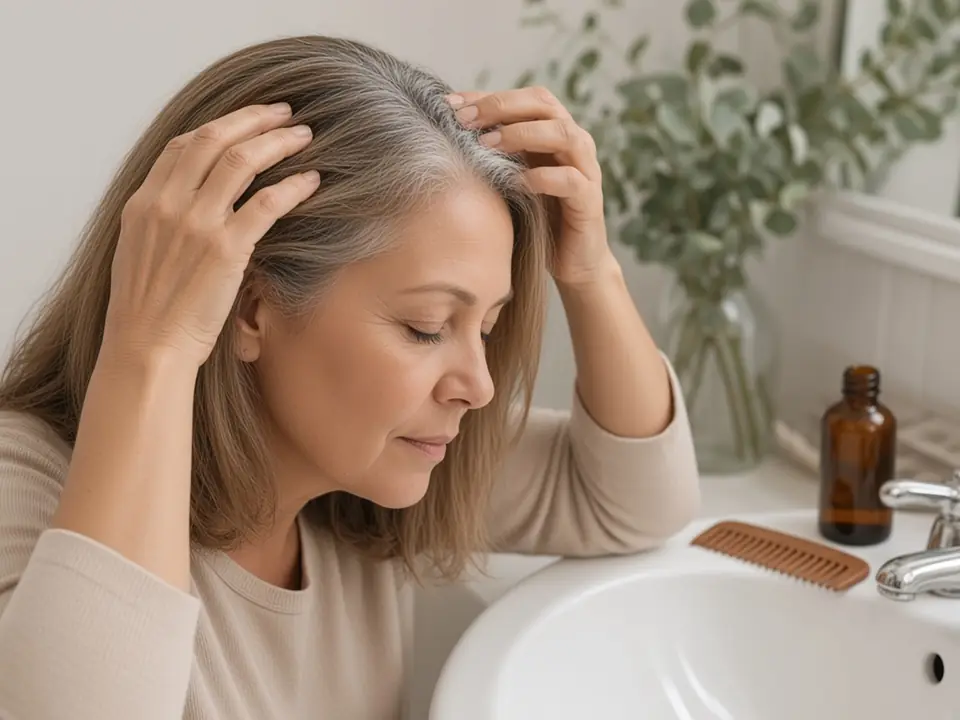
Some of the most moving moments I saw in the clinic were not about treatments at all. They were about a woman learning to wash her hair without dreading the plughole, finding a cut that suited her again or realising she did not have to give up the colour she loved. Everyday care cannot change your genes. It can reduce breakage, keep your scalp comfortable and help you feel like yourself.
This routine is drawn from The Menopause Hair Guide. It works alongside, not instead of, advice from a qualified hair expert or your GP. If anything on your scalp is painful, red, scaly or patchy, see your GP before changing products.[1]
Key points
A daily scalp routine
You do not need a ten step ritual. Consistency beats intensity.
- Notice, do not scratch. If your scalp itches, press with your fingertip pads rather than nails. Broken skin invites irritation.[2]
- Keep styles loose overnight. A silk or satin scrunchie, a loose braid or simply hair down reduces breakage at the temples and nape.
- Protect from the sun. If your parting is visible and you will be outside, use a hat or sun cream on exposed scalp.[1][2]
A gentle weekly wash routine
How often you wash depends on your scalp, texture, activity and any medicine instructions. There is no universal interval. Wash often enough to remove sweat and build up without making your scalp sore.
- Detangle first. Work gently in sections from the ends upwards. Use conditioner for slip if your texture needs it. Support each section so you do not tug the scalp.
- Use lukewarm water. Very hot water feels comforting but can leave the scalp thirsty.
- Shampoo the scalp, not the ends. Put a small amount on your fingertips and move in small circles over the whole scalp, including the nape. Let the suds run through the lengths.
- Rinse well. Leftover cleanser can itch.
- Condition the lengths. Keep rich conditioner off a fine, thinning crown if it leaves it flat. Curly and coily hair may prefer a creamier conditioner and a less frequent wash.
- Optional: a two minute scalp moment. Gentle fingertip circles may feel soothing. Massage is not an established treatment for hair loss, so enjoy it for comfort and stop if it hurts.
- Blot, do not rub. Use a soft towel or a cotton T shirt. Wet hair stretches and snaps.
Drying and heat
Squeeze water downwards with your hands. If you blow dry, hold the dryer at a distance, use a warm rather than hottest setting and keep it moving. A heat protectant on the lengths reduces obvious scorch. Women's Health Concern suggests that using fewer straighteners, dryers and other heat tools may improve how menopausal hair looks.[1]
Air drying with a loose clip lifting the roots can give fine hair a little more height than drying it flat against your head.
Colour and chemical services
You do not have to give up colour. Many women feel more themselves with a well chosen shade. Ask your colourist about:
- fewer successive bleach sessions
- glosses instead of high lift dyes where possible
- longer gaps between appointments
- avoiding tight foils at a fragile hairline
Relaxers, frequent bleaching and back to back keratin treatments add breakage. If you use them, stretch the time between services and watch your hairline closely.
Cuts that help thinning hair look fuller
There is no single "menopause haircut". Texture decides a great deal, but a few ideas work for many women:
- Removing weight from heavy lengths can make the crown look less dragged down.
- Soft layers around the face draw the eye away from a widening part. Very thin, choppy layers can reveal more scalp.
- A fringe (bangs), if it suits you, can soften a temple or front parting.
- Very long hair on a thinning crown can make the contrast more obvious. Collarbone to shoulder length is a common sweet spot, not a rule.
- Curly and coily hair often looks fullest cut dry, in its natural shape, by someone who understands that texture.
- A slightly off centre or zigzag parting can hide more scalp than a strict centre parting.
Take a few photos of your parting to the salon so you and your stylist are looking at the same thing. Book a short consultation first and say you are noticing thinning.
Care by hair type
| Hair or style | Try this | Avoid |
|---|---|---|
| Fine and straight | Light conditioner on lengths, gentle root lift, low heat | Heavy products on the crown, repeated backcombing |
| Wavy | Light product, loose drying, gentle detangling | Over brushing for volume, too many thin layers on top |
| Curly | Detangle in sections with plenty of slip; optional low heat diffuser | Tight slicked back styles to hide a parting |
| Coily | Section and condition well; cleanse the scalp without harsh scrubbing | Tight bands, adhesives on irritated skin |
| Locs, braids and protective styles | Keep the scalp accessible for cleansing; ask for low tension and lighter weight | Tight retwists or heavy extensions over thinning areas |
Pain, bumps and pulling are not a normal cost of any style. New crown loss, scalp symptoms or a retreating hairline needs assessment whatever your hair type.[4][5]
Products: appearance, not biology
The American Academy of Dermatology notes that hair loss shampoos may help hair hold moisture, so it looks thicker, or reduce breakage. They cannot regrow hair or stop pattern loss.[3] Women's Health Concern also mentions thickening shampoos and conditioners as a way to improve appearance.[1]
Look for lightweight volume at the roots if your hair is fine and straight and richer moisture on the lengths if your hair is curly, coily or newly dry. There are no miracle oils. Oils can make coils more manageable, but keep them off broken or irritated skin.
Your gentler styling checklist
- I detangle from the ends and support the roots
- I have swapped tight elastics for a soft scrunchie or clip
- I have cut down high heat on at least a few days a week
- I have tried an off centre parting in good daylight
- I have told my hairdresser I am noticing thinning
- I am not using heavy extensions on fine or shedding hair
Make it a 12 week habit
The Menopause Hair Guide turns this routine into weekly action cards, a routine checklist and a monthly photo method, with a texture companion for every hair type.
Keep reading
- Menopause hair loss: a clear starting point
- Shedding, thinning or breakage: what is different?
- Nutrition and menopausal hair: food first
Frequently asked questions
How often should I wash thinning hair in menopause?
There is no universal interval. Wash often enough to keep your scalp clean and comfortable without making it sore. Fine straight hair may need washing more often than curly or coily hair. Washing does not cause hair loss; the hairs you see were already shed.
Can I still colour my hair if it is thinning?
Yes. Ask your colourist about gentler approaches such as fewer bleach sessions, glosses and longer gaps between appointments. Tell them you are noticing thinning so they avoid tight foils at a fragile hairline.
Do thickening shampoos work?
They can help hair look fuller or reduce breakage, but they cannot regrow hair or stop pattern hair loss. Choose them for appearance, not as a treatment.
This article is general education, not medical advice. It cannot diagnose or treat any condition. Speak to a qualified hair expert or your GP about hair changes and seek medical help promptly for the warning signs above.
Sources
Sources were checked on 8 November 2026. Numbers in the text link to this list.
- Women’s Health Concern (patient arm of the British Menopause Society). Menopausal hair loss: more than ‘a bad hair day’. Factsheet. November 2025. Source
- British Association of Dermatologists and British Hair and Nail Society. Hair loss: female pattern (androgenetic alopecia). Patient Information Leaflet. Updated October 2024. Next review October 2027. Source
- American Academy of Dermatology. Thinning hair and hair loss: could it be female pattern hair loss? Last updated 13 December 2022. Source
- British Association of Dermatologists. Frontal fibrosing alopecia. Patient information leaflet. Updated July 2018. Source
- American Academy of Dermatology. Hair loss types: Central centrifugal cicatricial alopecia signs and symptoms. Updated 14 March 2022. Source