Menopause hair · Evidence led
Nutrition and menopausal hair: food first
Food will not override genetics or replace a medicine. A steady, varied pattern of eating does support the body that grows your hair.
"What should I be eating?" was one of the questions I heard most in the clinic, usually followed by a photo of an expensive bottle of hair vitamins. The honest answer is less exciting and far more useful. Your hair is built by the same body that needs enough protein, iron, vitamins and rest. Feeding that body well, without crash diets or guesswork, is one of the kindest things you can do.
This article is general education based on NHS guidance and published reviews. If you have a medical diet, diabetes, coeliac disease, kidney disease or allergies, ask your GP or a registered dietitian before making big changes. For the wider picture, read our menopause hair loss guide.
Key points
- A healthy, varied diet supports general health and may be a helpful part of menopause hair care.[1]
- Crash dieting can affect hair growth.[1]
- Treating a proven deficiency is sensible. Supplements without a deficiency have weak support.[2][3]
- UK adults should consider 10 micrograms of vitamin D daily in autumn and winter.[4]
- Biotin can distort blood tests. Tell whoever takes your blood.[5]
Build meals around the Eatwell pattern
The NHS Eatwell Guide is a practical picture of a balanced plate: plenty of fruit and vegetables, starchy foods (ideally wholegrain), some beans, pulses, fish, eggs, meat and other proteins, some dairy or alternatives and only small amounts of foods high in fat, salt and sugar.[6]
For hair, the most useful translation is simple:
- Include a protein food at most meals.
- Pair plant iron with a vitamin C food, such as lentils with tomatoes or peppers.
- Eat oily fish once a week if you can.
- Include eggs, nuts, seeds, green vegetables and fortified foods as you enjoy them.
Protein
Each hair is built from keratin, a protein. You do not need a special hair protein powder. You need enough ordinary protein, spread through the day, especially if you have been skipping meals or following a very low calorie plan. Women's Health Concern lists crash dieting among the stresses that can affect hair growth.[1]
If you are eating less meat, lean on eggs, dairy or fortified alternatives, fish, tofu, tempeh, beans and lentils.
Iron
Lower ferritin (iron stores) has been associated with some types of hair loss in women, though studies do not all agree.[7][3][8] Heavy periods in perimenopause can lower iron.
Good food sources include red meat, beans and chickpeas, nuts, dried apricots, fortified breakfast cereals and soy flour.[9] The NHS also advises limiting red and processed meat because of a probable link with bowel cancer, so more is not always better.[9]
If a test shows deficiency, your GP may recommend a supplement at a specific dose. Do not guess a high dose yourself.[9] Treating iron without a proven deficiency is not well supported for hair.[3]
Vitamin D
Vitamin D is important for bones, teeth and muscles. In the UK, sunlight is not strong enough for the body to make enough from October to early March. Government advice is that everyone should consider a daily 10 microgram (400 IU) supplement in autumn and winter. Some people should take it all year, including those who are rarely outdoors, cover most of their skin or have dark skin. Do not take more than 100 micrograms (4,000 IU) a day unless a doctor advises it.[4]
Vitamin D has been studied in relation to hair, but the evidence is not strong enough to treat high dose vitamin D as a hair therapy.[2] Think of the NHS dose as general health advice you may already need, not a regrowth plan.
Zinc, B vitamins and other nutrients
Zinc, selenium, B vitamins and essential fatty acids all appear in reviews of diet and hair. Deficiencies can matter. Extra tablets in someone who already eats well often do not.[2]
Biotin and hair supplements
Biotin deficiency is uncommon. Taking biotin "just in case" has little support.[2][10] High dose biotin can interfere with laboratory tests, including some used to check for a heart attack.[5][11] If you take it, tell whoever takes your blood. They will tell you whether anything needs pausing.
Findings for hair supplements in general are mixed, with no effect on growth or thickness in most studies.[10] Before buying, ask:
- Do I have a proven deficiency that this treats?
- What is the evidence for each ingredient, in people like me?
- Could it interact with my medicines or affect blood tests?
- What will it cost each month and for how long?
A hair friendly store cupboard
A few basics make protein and iron easier on tired days:
- tinned lentils, chickpeas and beans
- eggs
- tinned salmon, sardines or mackerel
- frozen spinach, peas and berries
- porridge oats and fortified cereal
- wholemeal bread or wraps
- nuts, seeds and nut butter
- plain or Greek style yoghurt
Three easy meal ideas
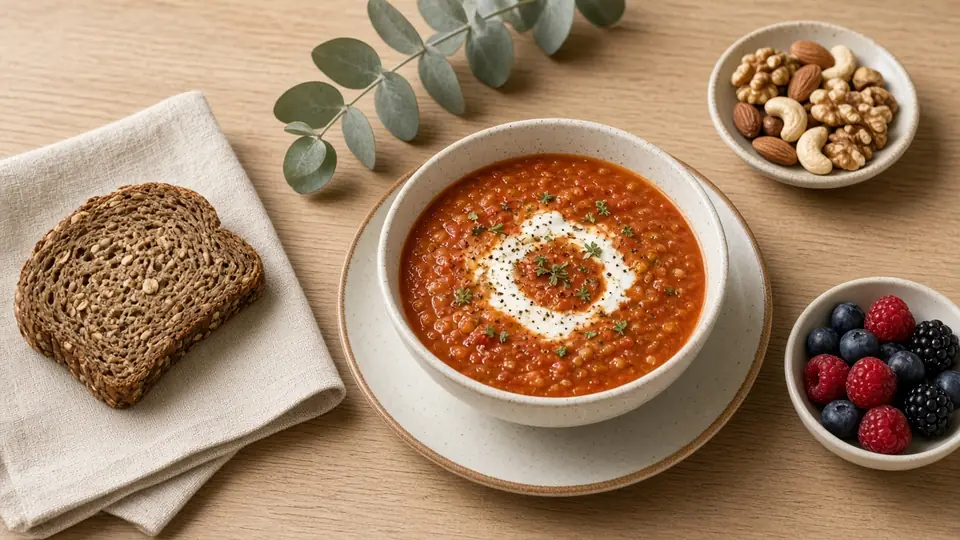
Red lentil and tomato soup. Soften an onion, add red lentils, a tin of tomatoes and stock, then simmer until soft. Serve with a spoon of yoghurt and seeded bread.
Egg and spinach scramble. Wilt a handful of spinach in a pan, pour in beaten eggs and stir slowly over a low heat. Serve on wholegrain toast with grilled tomatoes.
Yoghurt breakfast bowl. Plain yoghurt topped with oats, berries and a teaspoon of seeds. Breakfast in three minutes on the days you cannot face a pan.
On a tired day, simple still counts. Beans on wholemeal toast or an omelette with frozen spinach are reasonable meals. If your appetite has changed or you are losing weight without trying, mention it to your GP.
When to see your GP
Ask your GP about tests if you have heavy periods, a limited diet, tiredness, breathlessness or shedding that does not settle. Your GP will choose tests based on your history. There is no universal hair panel.[1][12] Our article on hair thinning after 50 explains which tests may be considered.
A full 7 day plan
The Menopause Hair Guide includes a 7 day hair friendly meal plan with vegetarian swaps, simple recipes and a store cupboard list, alongside the rest of your 12 week plan. No meal is a regrowth treatment, but ordinary food done well supports everything else.
Keep reading
- Menopause hair loss: a clear starting point
- Menopause hair loss treatments: an evidence guide
- A gentle haircare routine for midlife
Frequently asked questions
What vitamins help with menopause hair loss?
Treating a proven deficiency, such as iron or vitamin D, is sensible for general health. Extra supplements in someone who already eats well have weak evidence for hair. UK adults should consider 10 micrograms of vitamin D daily in autumn and winter.
Does biotin help menopause hair loss?
Biotin deficiency is uncommon and taking biotin just in case has little support. High dose biotin can also distort some blood tests, including some heart tests, so always tell whoever takes your blood.
Should I take iron for hair loss?
Only if a test shows you need it. Your GP may recommend iron at a specific dose if you are deficient. Do not guess a high dose yourself.
This article is general education, not medical advice. It cannot diagnose or treat any condition. Speak to a qualified hair expert or your GP about hair changes and seek medical help promptly for the warning signs above.
Sources
Sources were checked on 8 November 2026. Numbers in the text link to this list.
- Women’s Health Concern (patient arm of the British Menopause Society). Menopausal hair loss: more than ‘a bad hair day’. Factsheet. November 2025. Source
- Almohanna HM, Ahmed AA, Tsatalis JP, Tosti A. The role of vitamins and minerals in hair loss: a review. Dermatol Ther (Heidelb). 2019;9(1):51 to 70. PMID: 30547302. Source
- Trost LB, Bergfeld WF, Calogeras E. The diagnosis and treatment of iron deficiency and its potential relationship to hair loss. J Am Acad Dermatol. 2006. doi: 10.1016/j.jaad.2005.11.1104. PMID: 16635664. Source
- NHS. Vitamin D. Source
- US Food and Drug Administration. Biotin interference with troponin lab tests: assays subject to biotin interference. Source
- NHS. The Eatwell Guide. Source
- Kantor J, Kessler LJ, Brooks DG, Cotsarelis G. Decreased serum ferritin is associated with alopecia in women. J Invest Dermatol. 2003;121(5):985 to 988. PMID: 14708596. Source
- Treister-Goltzman Y, Yarza S, Peleg R. Iron Deficiency and Nonscarring Alopecia in Women: Systematic Review and Meta-Analysis. Skin Appendage Disord. 2022;8(2):83 to 92. doi: 10.1159/000519952. PMID: 35415182. Source
- NHS. Iron. Page last reviewed 3 August 2020. Source
- American Academy of Dermatology. Thinning hair and hair loss: could it be female pattern hair loss? Last updated 13 December 2022. Source
- Manchester University NHS Foundation Trust. Potential for biotin interference in immunoassays. Laboratory notice. Source
- National Institute for Health and Care Excellence. Menopause: identification and management. NICE guideline NG23. Last reviewed 15 April 2026. Source